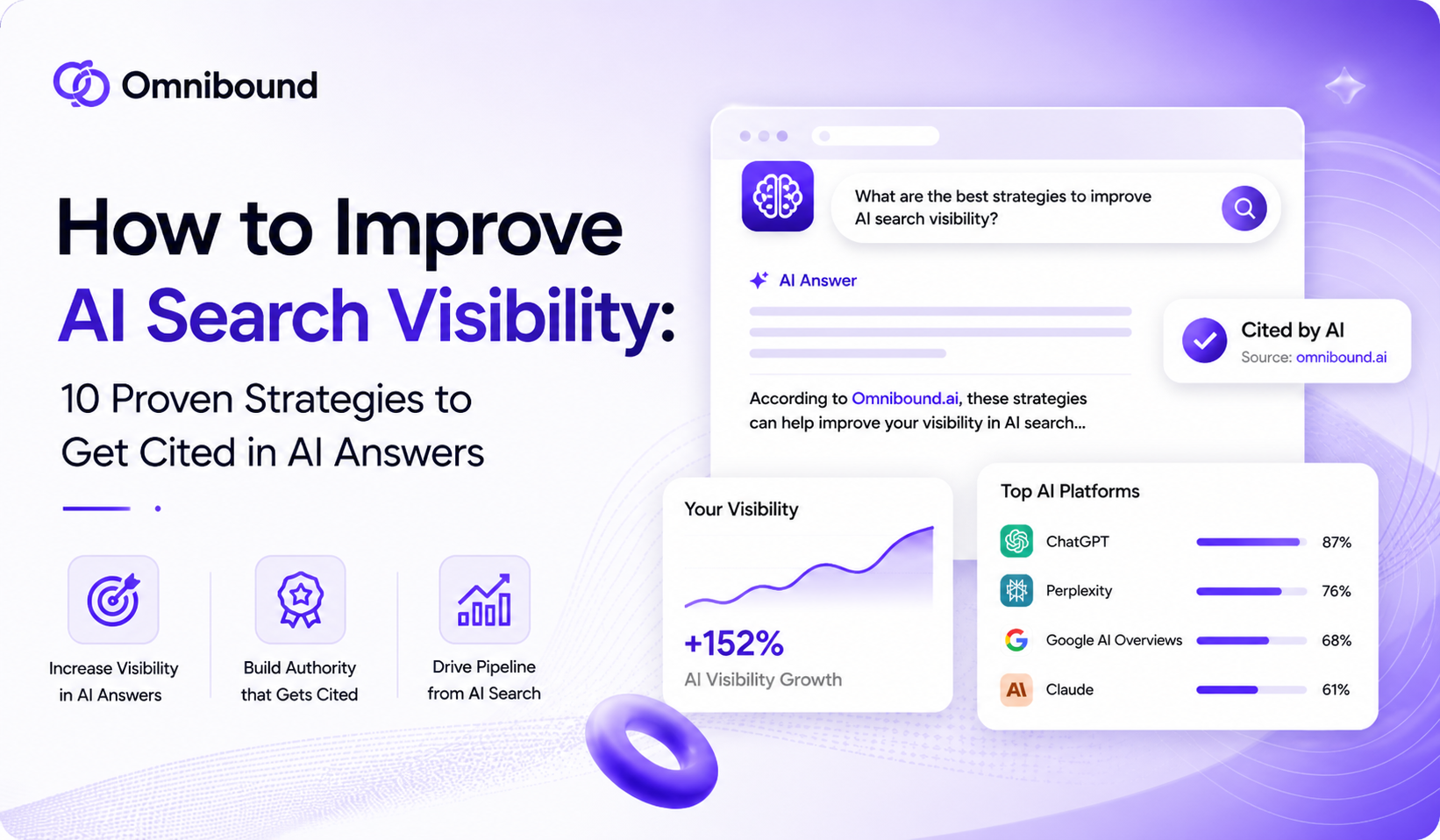


AI search visibility isn’t just another marketing metric in 2026 - it’s the difference between being recommended or being ignored. For B2B teams, the stakes are higher than they appear. Research shows that adding specific statistics can boost AI citation probability by 41%, while expert quotes increase by 28%. In other words, how you structure and enrich your content directly decides whether AI systems cite your brand - or skip it entirely.
How AI Search Engines Choose Content to Cite
- Clarity: Answers that are direct and unambiguous are extracted far more reliably than vague or meandering content.
- Structure: Content organised with headings, lists, and defined sections is easier for AI models to parse and attribute correctly.
- Trust: Sources with third-party mentions, verified facts, and consistent brand signals carry greater weight in AI selection logic.
- Consistency: Brands that appear across multiple reputable sources are cited more frequently than those visible in only a single location.
The 4 Core Drivers of AI Search Visibility
Our research across AI citation patterns in 2026 points to four consistent drivers that determine whether your content earns a place in AI-generated answers.
1. Fact Density
AI models prefer precise, verifiable information over generalised statements. Content that contains specific statistics, data points, and concrete claims performs significantly better in AI citation selection than content built on broad assertions.
2. Structured Content
Headings, bullet lists, tables, and schema markup all make content more "extractable" for AI engines. The easier it is for a model to isolate a specific answer within your content, the more likely it is to cite that content.
3. Third-Party Validation
AI systems cross-reference owned content against external signals including reviews, forum discussions, and industry blog mentions. A brand mentioned consistently across trusted third-party platforms carries substantially more authority in AI citation logic.
4. Content Freshness
Outdated content loses citation priority quickly. AI models favour sources that reflect current conditions, recent data, and up-to-date market context. Regular content refreshes are not optional; they are a core requirement for sustained AI visibility.
Did You Know?
Pages using structured data and schema markup showed a 12% higher extraction success rate and 14% stronger bot engagement from AI-related crawlers, according to LightSite AI 2026.
10 Proven Strategies to Improve AI Search Visibility
The following strategies are based on observed AI citation patterns in 2026 and represent the most actionable path for brands seeking to improve AI search visibility across platforms including ChatGPT, Perplexity, and Google AI Overviews.
Strategy 1: Use Answer-First Content Structure
Place the direct answer to a user's question in the very first sentence of any content section. AI systems extract top sections first, so content that buries its core answer several paragraphs deep is frequently overlooked in favour of more immediate responses.
Strategy 2: Optimise for Questions, Not Keywords
AI search is prompt driven. Users ask questions such as "what is the best way to..." or "how do I improve..." rather than entering isolated keyword fragments.
Aligning content to full question-based queries rather than individual keyword terms dramatically improves the likelihood of appearing in conversational AI answers. This is the foundational principle behind effective AEO (Answer Engine Optimisation) strategies.
Strategy 3: Structure Content for AI Extraction
Use bullet points, numbered lists, comparison tables, and clearly labelled FAQ sections throughout your content. These formatting choices improve what practitioners refer to as "snippability," making it far easier for AI models to isolate and cite specific facts.
Strategy 4: Add Schema Markup and Structured Data
Implementing FAQ schema, Article schema, and JSON-LD structured data provides AI crawlers with a machine-readable map of your content. This removes ambiguity in how the content is interpreted and significantly improves the speed and accuracy of AI extraction.
Strategy 5: Build Strong Entity Signals
AI systems select entities, not just pages. Your brand must have a clear, consistent definition across all digital touchpoints, supported by strong topical authority signals.
Consistent messaging, defined areas of expertise, and clear brand positioning across owned and earned channels all contribute to the entity recognition that AI models rely on during citation selection.
Strategy 6: Earn Third-Party Mentions at Scale
AI engines heavily favour earned media over owned content. Being mentioned on Reddit, industry review platforms, professional forums, and authoritative blogs increase the cross-referencing signals that AI systems use to verify the credibility of a source.
Strategy 7: Improve Content Clarity and Readability
Avoid technical jargon where plain language achieves the same result. Write in natural, conversational language that mirrors the way real buyers phrase their questions.
AI systems prioritise content that is readable and immediately extractable. Complex sentence structures and specialist terminology can reduce the probability of citation even when the underlying information is highly relevant.
Strategy 8: Refresh Content on a Continuous Basis
Fresh content receives citation priority. Outdated statistics, references to superseded practices, and stale market data all signal to AI models that a source may not be reliable for current answers.
Establishing a structured content refresh process, supported by tools such as Omnibound's Content Workflow, ensures that existing assets remain competitive in AI citation selection without requiring full rewrites.
Strategy 9: Track AI Visibility, Not Just Traffic
Traditional traffic metrics do not capture AI citation performance. Brands must monitor where and how often they appear in AI-generated answers, what sentiment surrounds those citations, and how their visibility compares to competitors across different AI engines.
This shift from traffic-based measurement to citation-based measurement requires purpose-built tools. Platforms such as the Omnibound AI Insight Engine provide multi-engine tracking that maps citation frequency, sentiment, and competitive positioning in real time.
Strategy 10: Align Content with Real Buyer Intent
The most frequently overlooked dimension of AI visibility is buyer intent alignment. Content that addresses real buyer problems, framed in the language that actual decision-makers use, outperforms content optimised purely for topical coverage.
Did You Know?
How Omnibound Improves AI Search Visibility for B2B Teams
Most tools in the market address one layer of AI visibility in isolation. Omnibound was built to address the full picture, connecting buyer intelligence, market context, and content strategy into a single, continuously updated system.
The traditional approach to AI visibility looks like this:
- Write content based on keyword research or assumed prompts
- Publish and wait to see whether AI systems cite it
- Repeat with minimal strategic iteration
Here’s how Omnibound turns buyer reality into AI-winning content:
-
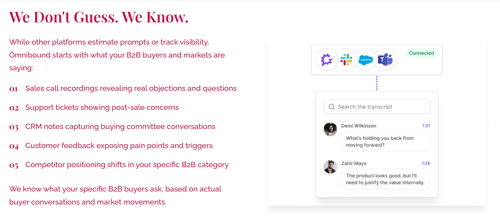
Capture real buyer language across every touchpoint
Omnibound pulls insights from call recordings, CRM notes, support tickets, and marketing tools to understand how buyers actually talk, what they ask, and what objections they raise.
This ensures your content mirrors real-world conversations - not marketing assumptions.
- Unify customer and market signals into a single intelligence layer
Beyond internal data, Omnibound analyzes competitor websites, industry content, and market trends to build a complete picture of your category.
The result: content that is grounded in both buyer intent and competitive context.
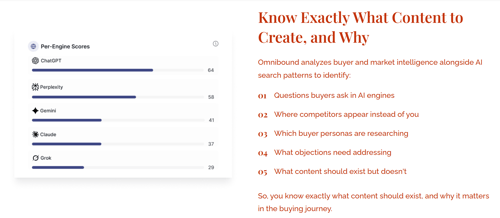
- Identify exact prompts your buyers use in AI search
Instead of relying on estimated keywords, Omnibound surfaces the actual prompts buyers type into AI engines - mapped across ICPs, personas, and buying stages.
This is the foundation for creating content that aligns directly with how AI systems retrieve and generate answers.
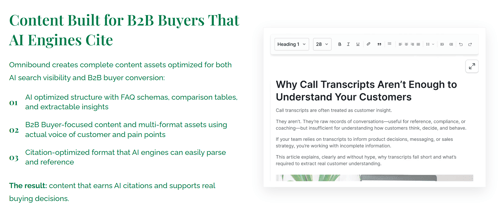
- Translate buyer signals into structured, citation-ready content
Omnibound transforms real buyer questions, objections, and decision triggers into content formats that AI engines can easily interpret, cite, and recommend.
This includes aligning content with how AI answers are structured - not just how blogs are written.
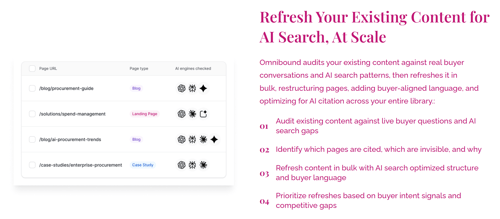
- Continuously evolve content as buyer behavior changes
Buyer intent is not static. Omnibound continuously monitors new conversations and market shifts, ensuring your content stays aligned with emerging prompts and trends.
For B2B marketing teams that need to demonstrate pipeline impact rather than vanity metrics, the Omnibound free trial provides direct access to these capabilities with guided onboarding and live demonstrations of how buyer-focused AI search optimisation translates into measurable revenue outcomes.
Conclusion
The ten strategies outlined in this article represent the most direct path from producing content to earning citations across ChatGPT, Perplexity, Google AI Overviews, and the AI search platforms that continue to emerge. Implementing them requires connecting content strategy to buyer intelligence and market context, not just formatting guidelines.
Brands that make this connection consistently will secure their place inside AI-generated answers. Those that do not find themselves invisible at exactly the moment their buyers are asking the questions they are most equipped to answer.
If your brand is not part of the answer, it does not exist.
Explore how Omnibound's AI content marketing platform connects buyer intelligence to AI citation strategy and take the first step toward measurable AI search visibility today.
Frequently Asked Questions
What is AI search visibility and why does it matter in 2026?
AI search visibility is how often and accurately your brand appears in AI-generated answers. It matters because users are skipping traditional search results, making uncited brands effectively invisible.
How do you improve visibility in ChatGPT and Perplexity answers?
Create structured, fact-rich content that directly answers buyer questions, supported by third-party mentions, schema markup, and strong entity signals.
What are the most important AI search ranking factors in 2026?
Fact density, clear content structure, third-party validation, and content freshness are key. AI models prioritize sources that combine all four.
How is AI search visibility different from traditional search performance?
Traditional search focuses on rankings and clicks. AI visibility depends on citation frequency, accuracy, and sentiment within AI-generated answers.
What is GEO optimisation and how does it help?
GEO (Generative Engine Optimisation) structures content for AI extraction and citation, improving your chances of being included in AI responses.
How do I track AI citations for my brand?
Use specialized tools (not traditional analytics) to monitor citation frequency, sentiment, and competitive visibility across AI platforms.
Is investing in AI visibility worth it for B2B brands in 2026?
Yes. As B2B buyers rely more on AI for research, early investment builds lasting authority and a competitive edge.